
Most couples planning their door gifts make the same mistake: they pick based on how the mug looks in a product photo, not on whether it survives being packed into 200 gift boxes, shipped to a hall, and handed to a guest who’s already juggling a phone, a red packet, and a plate of food. That’s the gap between a door gift that gets used for years and one that ends up in a kitchen cabinet, untouched, by the following Chinese New Year.
The mug-with-straw format — usually a double-layer glass or acrylic cup with a leather or silicone sleeve, a lid, and a built-in straw — has quietly become one of the most requested door gift categories in Malaysia over the past two to three years. And there’s a reason it’s replaced the plain ceramic mug as the default: it photographs well on the gift table, it doesn’t scream “cheap door gift,” and unlike a mug that just sits there, a straw cup gets pulled out and used at the office desk or in the car within days of the event.
A mug with straw makes sense as a door gift when your budget sits around RM3–RM6 per unit, your guest count clears the supplier’s MOQ (commonly 200 pieces), and you can commit to ordering roughly 2 months ahead. It’s a weaker choice if your guest list is under 100, if you need same-month delivery, or if you’re set on heavy customization like full-color printed inserts rather than a simple sleeve label.
But here’s what most people miss:
- The price you see quoted (like RM3.50) is almost always the bare unit cost — sleeve engraving, box packaging, and ribbon are usually quoted separately, and that can add 30–60 sen per piece.
- MOQ isn’t just a supplier rule to negotiate around — it’s tied to how the glass and leather sleeves are batch-cut and printed. Ordering 150 pieces when MOQ is 200 doesn’t get you a discount; it often just gets you a “sorry, can’t do it” or a higher per-unit price to cover the wasted material.
- “Pre-order 2 bulan” (2 months) isn’t padding. Glass takes longer to mold and cool than plastic, and leather sleeve cutting is usually outsourced, so any delay in that step pushes your whole timeline back — and wedding suppliers in Malaysia get booked solid around the November–February peak season.
This piece covers what actually drives the cost and quality of a mug-with-straw door gift, how to decide if it fits your event, and the ordering mistakes that cost people the most time.
What a Mug With Straw Door Gift Actually Is (And Why the Format Works)
At its simplest, it’s a double-wall drinking vessel — usually clear or tinted glass, sometimes acrylic — wrapped in a leather or faux-leather sleeve for grip, topped with a lid that has a straw slot, and paired with a reusable straw (glass, stainless, or plastic).
What makes it work as a door gift specifically, rather than just a nice cup, comes down to three things suppliers rarely explain upfront. First, the sleeve isn’t just decorative — it’s what protects the glass during the actual event. Guests aren’t gentle with door gifts; they get tossed into goodie bags with candy and cards. A bare glass mug chips. A sleeved one usually survives. Second, the color variety (amber, clear, smoky black, as you’ll typically see in a supplier’s sample lineup) lets one design serve multiple aesthetic themes — rustic, minimalist, or dark elegant — without reprinting anything. That’s a real cost saver if you’re choosing between a solid-color palette and a fully custom print. Third, and this is the part suppliers won’t volunteer: the straw is usually the first thing that gets lost or misplaced by the guest within the first month. If longevity of the complete set matters to you, ask specifically whether replacement straws are sold separately, because most aren’t.
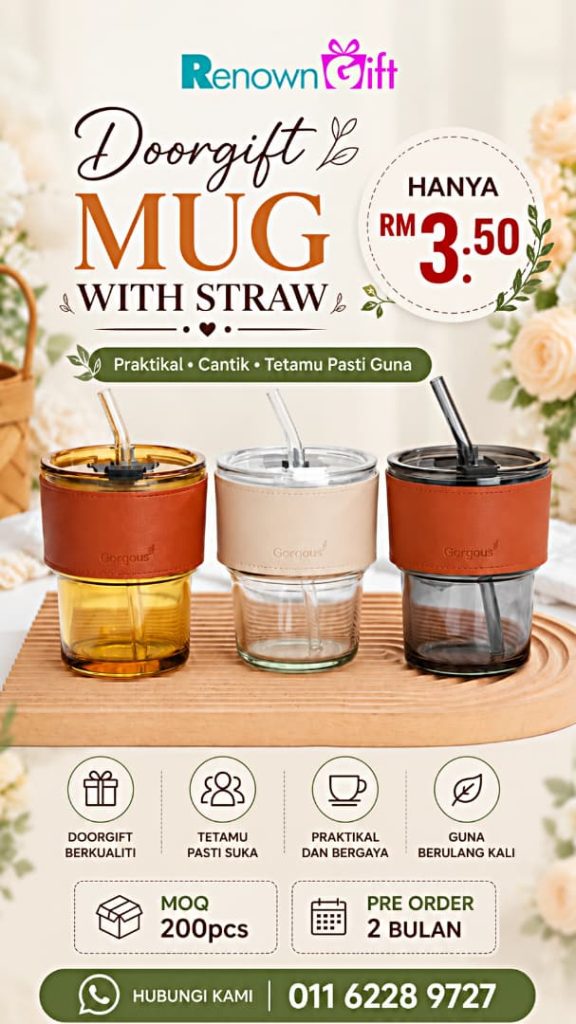
Where this goes wrong in practice: couples sometimes assume “double-wall glass” means insulated like a thermos. It doesn’t, in most units at this price point — it just adds a bit of heat-shielding for cold drinks and looks more premium. If insulation is actually the point (say, for a summer outdoor event), you need to ask for double-wall vacuum construction specifically, which is a different product tier and price.
Is It the Right Door Gift for Your Event? A Quick Decision Framework
Not every event should default to a mug with straw, even though it’s trending. Here’s the honest breakdown.
| Situation | Mug with Straw | Better Alternative |
|---|---|---|
| Guest count 200+, budget RM3–6/pax | Strong fit — MOQ works in your favor, per-unit cost drops | — |
| Guest count under 100 | Weak fit — you’ll likely pay above the quoted rate or get turned away for being under MOQ | Small-batch items: printed tote bags, candles, local bakes |
| Need delivery within 3–4 weeks | Risky — glass + sleeve production rarely compresses that fast | Ready-stock items: keychains, notebooks, pre-made hampers |
| Want deep personalization (photos, multi-color print) | Possible but pricier — ask if it’s pad printing, UV printing, or laser engrave, since each changes cost and durability | If budget-sensitive, go engraved name-only instead of full photo print |
| Outdoor/summer event, want drinks to stay cold | Only if vacuum-insulated construction confirmed | Insulated tumbler (different product line) |
| Formal / traditional Malay or Chinese wedding theme | Works well — neutral colors like amber and clear glass suit most palettes | — |
Implementation checklist (rough difficulty and time cost):
- Confirm guest count and buffer for last-minute add-ons (add 5–10% extra units) — Easy, 10 minutes
- Decide sleeve color(s) — single color across all units is cheapest; mixed colors for variety adds sorting complexity at packing — Easy, same day
- Confirm what’s included in the quoted price (unit only vs. unit + box + engraving) — Medium, needs a direct question to supplier
- Lock in order date — work backward from event date, leave 2 months minimum, add 2–3 weeks buffer for peak wedding season (Nov–Feb, and around CNY) — Medium, requires calendar discipline
- Ask about sample unit before committing to 200 pcs — Easy but often skipped, and it’s the single most common regret people report after the fact
What Actually Drives the Price Difference Between Suppliers
Two suppliers can both quote “RM3.50 mug with straw” and hand you meaningfully different products. The variables that matter, in order of what actually moves the price:
Glass thickness and whether it’s tempered — thin, non-tempered glass is cheaper and is the main reason some batches arrive with a few cracked units despite careful packing. Sleeve material — genuine leather-look PU versus a thin printed fabric wrap changes both feel and durability, and it’s hard to tell from a photo alone. Printing/branding method — a sticker label is cheapest and lowest durability; heat-transfer or laser engraving on the sleeve costs more but survives dishwashing (though most of these aren’t dishwasher-safe regardless, worth confirming). Packaging — whether it comes in a plain poly bag versus a branded box with ribbon, which matters more than people expect for the “unboxing moment” that gets guests to actually keep and use the gift rather than regift it.
The real-world reality: the single biggest driver of guest satisfaction with a mug door gift isn’t the branding or the box — it’s whether the straw fits snugly and doesn’t rattle, and whether the lid seals well enough that a guest can toss it in a bag without a coffee stain incident. These are the details that never show up in a product listing but are exactly what determines whether someone keeps using it six months later or quietly retires it to the back of a cupboard.
The Bigger Picture
The door gift market in Malaysia keeps drifting toward items that double as everyday-use products rather than pure novelty — this is part of why mugs with straws, reusable tote bags, and tumbler sets have edged out trinkets and fridge magnets in popularity. If you’re choosing between door gift categories, the question worth asking isn’t “what looks nicest in the box” but “what will this guest actually still be using in three months.” A mug with straw, done with attention to sleeve quality and lid seal, tends to score well on that second question — which is ultimately the only metric that matters once the event itself is over and the thank-you cards are all that’s left.