
Walk into any wedding dinner in Klang Valley and check the door gift table before the reception even starts. Nine times out of ten, somewhere in that pile of little wrapped boxes, there’s a tissue box. Not because it’s exciting — nobody gasps when they unwrap one — but because it survives. Long after the confetti’s swept up and the balloon arch is in a landfill, that tissue box is still sitting on someone’s dashboard or office desk, doing its job every single day.
That’s really the whole argument for tissue box door gifts in one sentence: they’re the rare gift that doesn’t get thrown away, because throwing away something you’ll need again next week feels wasteful even to the most ruthless declutterer.
Quick answer: a well-made tissue box door gift in Malaysia typically costs between RM2.50 and RM8 per piece depending on the tissue brand, box material, and customisation, and it works best for weddings, open houses, corporate appreciation events, and funerals — pretty much anywhere you need a gift that’s useful rather than sentimental.
But here’s what most people organizing their first event completely miss: the tissue box isn’t the gift — the box holding the tissue is. Guests forget the tissue brand within a week. They remember whether the box looked cheap and started peeling at the corners after one humid car ride, or whether it held up and quietly became part of their car’s glovebox rotation for the next two years.
Where Tissue Boxes Actually Fit (And Where They Don’t)
Malaysian door gift culture runs on an unspoken rule: the gift should cost less than the joy of receiving it, but not so little that it insults the guest. Tissue boxes hit that sweet spot for a specific reason — they’re one of the few items that’s genuinely useful across every demographic in the room, from your auntie’s generation to the flower girl’s parents.
They work brilliantly for weddings and engagement dinners, where guest counts often run into the hundreds and the couple needs something that photographs nicely on a table without eating half the budget. They also show up constantly at Chinese and Malay funerals, where a tissue box is practical, understated, and doesn’t carry the awkwardness of a “celebratory” item. Corporate events and Hari Raya or Chinese New Year open houses use them too, usually branded with the company logo, because a tissue box sitting on someone’s desk is quiet advertising that never expires.
Where they don’t work as well: baby showers and birthday parties for kids, where guests — especially younger ones — expect something with more personality. A tissue box at a five-year-old’s birthday party reads as “the parents ran out of ideas,” even if that’s not remotely true.
What Actually Makes a Guest Keep It (Instead of Regifting It)
The honest answer, based on how these things actually get used after the event, comes down to three things nobody puts on the packaging label.
First, the box material matters more than people expect. Cheap PVC or thin cardboard boxes look fine under event lighting but start warping within a month, especially in Malaysia’s humidity — and a warped box goes straight into the bin. Acrylic and solid wood-grain finish boxes cost maybe 60 sen to RM1.50 more per unit but last years, which is the entire point of choosing a “useful” gift in the first place.
Second, the tissue quality inside is not a place to cut corners, even though it’s tempting since guests rarely check it on the spot. A scratchy, thin tissue tells guests everything about how much thought went into the gift, and word travels fast among relatives comparing notes after the dinner.
Third — and this is the one almost every first-time event organizer misses — the personalization needs to feel intentional, not like an afterthought sticker slapped on at the last minute. A printed tag with the couple’s names and wedding date, or a subtle engraved logo, changes how the box gets treated. Guests who receive a generic, unbranded tissue box tend to leave it behind on the table if they’re already carrying too much. Guests who receive a personalized one almost always take it.
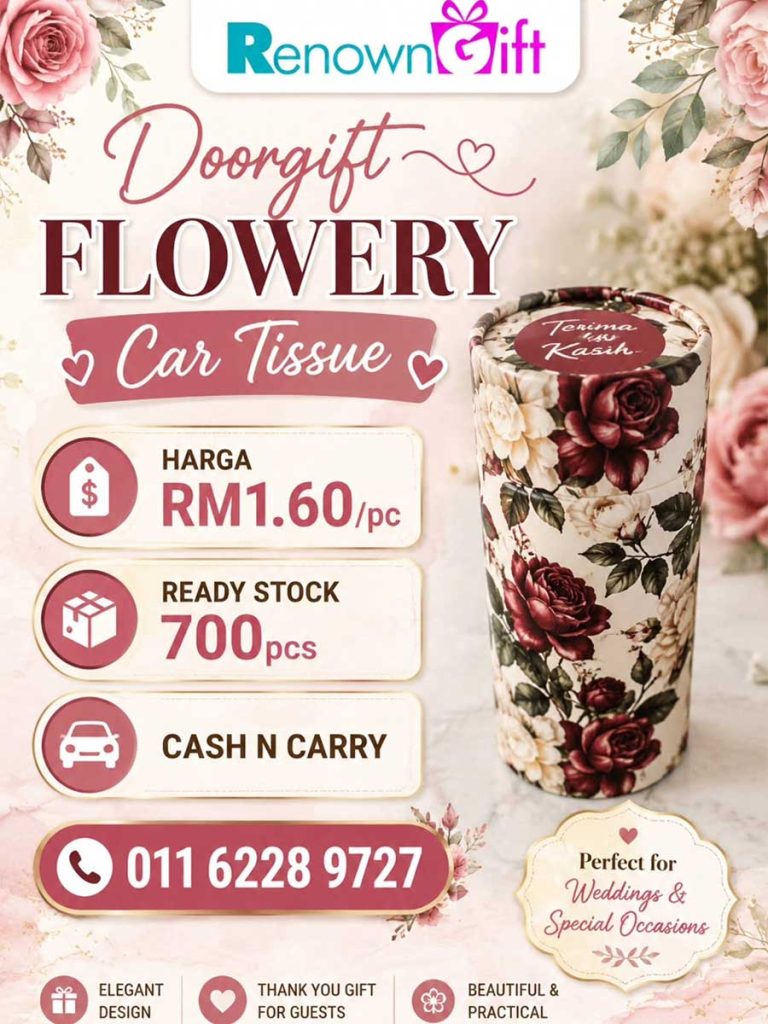
Budgeting It Properly: A Realistic Cost Breakdown
Most vendors in Malaysia quote per-piece pricing that hides the real cost until you’re deep into the order. Here’s roughly what you’re looking at, based on typical vendor quotes across Klang Valley, Penang, and Johor Bahru for orders between 100 and 500 pieces.
| Tier | Box Type | Price per Piece (RM) | Best For |
|---|---|---|---|
| Budget | Thin cardboard, printed wrap | 2.50 – 3.50 | Large guest lists (300+), corporate mass distribution |
| Mid-range | PVC or acrylic box, custom sticker | 4.00 – 5.50 | Weddings, open houses, most common choice |
| Premium | Wood-grain acrylic, engraved/embossed | 6.00 – 8.50 | Smaller intimate weddings, VIP corporate gifting |
A detail that catches people off guard: minimum order quantities usually sit at 50 to 100 pieces, and unit prices drop noticeably once you cross 300 pieces — which means ordering “just enough” for your exact guest count often costs more per piece than ordering a slightly larger batch and having a few spares for last-minute RSVPs.
The other cost that gets forgotten entirely is customisation lead time. Engraved or embossed boxes typically need 10 to 14 working days once the design is confirmed, not from when you place the order — the back-and-forth on design approval eats more time than the actual production does. Sticker-based customisation is much faster, often ready within 3 to 5 days, which makes it the fallback option when an event date sneaks up faster than planned.
Choosing Between the Common Formats
| Format | Typical Use Case | Watch Out For |
|---|---|---|
| Single tissue box | Weddings, funerals, general events | Thin material warping in humidity |
| Tissue box + small candy/tea packet combo | Chinese New Year, Hari Raya open houses | Higher cost, needs food-safe packaging compliance |
| Mini travel tissue pack (non-box) | Budget corporate events, mass giveaways | Feels less premium, easy to overlook on a table |
| Tissue box with car mount design | Weddings where couple wants a “useful” theme | Higher unit cost, longer production time |
If your event has a tight turnaround — under two weeks — go with sticker customisation on a mid-range acrylic box. It’s the format vendors can turn around fastest without the guest noticing any drop in perceived quality.
A Few Things This Guide Doesn’t Cover
This isn’t a comprehensive vendor directory, and pricing shifts depending on raw material costs, which have been volatile over the past couple of years due to import cost changes. Vendors in East Malaysia (Sabah and Sarawak) also tend to quote 10-15% higher due to shipping logistics, which isn’t reflected in the table above since most quotes are based on Peninsular Malaysia vendors.
It’s also worth noting that “what guests keep” is based on general patterns from wedding and event planning discussions rather than a formal survey — individual taste varies, and no door gift format is universally loved. Some hosts have moved toward eco-friendly alternatives like reusable pouches or seed packets specifically because tissue boxes, while practical, don’t carry an environmental story the way those alternatives do. If sustainability messaging matters more to you than raw practicality, that’s a genuinely different conversation than the one this guide is having.
The Bigger Picture
The reason tissue boxes keep showing up decade after decade in Malaysian event culture isn’t nostalgia — it’s that they solve the actual problem door gifts exist to solve: leaving a small, positive trace of the event in someone’s daily life without asking them to display sentimentality they don’t feel. A wedding favor that gets used every day for two years does more quiet relationship-building than a decorative item that sits in a drawer.
If you’re planning an event soon, the decision isn’t really “tissue box or not” — it’s how much you’re willing to spend on the box material and personalization to make sure it survives past the first car ride home. That’s the detail that separates a door gift guests actually keep from one that ends up in the hotel lobby bin before the night’s over.